The house that could ride out a week
Stand in your grandmother's kitchen for a minute. Or her mother's — whichever kitchen your family still tells stories about.
There's a pantry, and it is not a cabinet with two cans of soup. Quart jars of green beans she put up in August. Flour and sugar in tins. A chest freezer with a labeled paper taped to the lid. Downstairs, a shelf of things that got fixed instead of replaced: the toaster with the new cord, the coat with the careful patch at the elbow, a darning egg that saw actual use. Candles in the second drawer, and everyone knew it was the second drawer.
And a detail we tend to forget: at least two houses on her street had a key to hers. Not for emergencies, exactly. Just because that's who Ruth and the Kowalskis were.
That house could lose power for three days, or the road for a week, and dinner would still happen at six.
None of it had a name
Here's the part worth sitting with. Nobody called her a prepper — the word would have baffled her, and honestly she'd have found the whole identity a little dramatic. Nobody called her anything. Keeping a deep pantry, mending, knowing your neighbors: this wasn't a stance or a subculture or a purchase funnel. It was just called keeping house, and nearly every house on the street did some version of it.
Competence was ordinary culture. That's the thing we lost — not the jars, the ordinariness.
The trade we made
We should be honest about how we lost it, because it wasn't foolishness. Refrigeration meant you didn't need to preserve. Supermarkets meant the pantry was ten minutes away and always open. Cheap goods meant mending cost more than replacing. Each trade was individually sensible, and together they were genuinely liberating — a lot of that competence ran on her unpaid hours, and she'd be the first to tell you which parts she doesn't miss.
But we made the trade totally. We kept none of the margin. Her three weeks of food became our three days; her street full of keys became a row of houses that wave. The goal is not to reverse the trade and go back to canning under obligation. The goal is to buy back a little of the margin — voluntarily, and with better tools than she had.
And to be clear about which half mattered more: the jars were only half of it. The other half was that everyone knew who had what. The pantry was hers; the knowledge of it belonged to the street.
The ritual: adopt one grandmother-practice
This is the ritual stream, so here is something you can actually run, starting today and finishing within the week. Pick exactly one practice from the list below. Not three. One, done fully, beats a cart full of intentions.
- The deep shelf. Next grocery run, buy doubles of ten things your household already eats — beans, rice, oats, the pasta sauce you actually like. About $40. Put them on one dedicated shelf and eat from the front of it. Congratulations: you now rotate stock, like she did.
- The mend. Take one garment you were about to retire and repair it where the repair shows — a visible mending kit turns the patch into a small brag instead of an apology. She darned invisibly out of thrift; you get to do it loudly, out of pride.
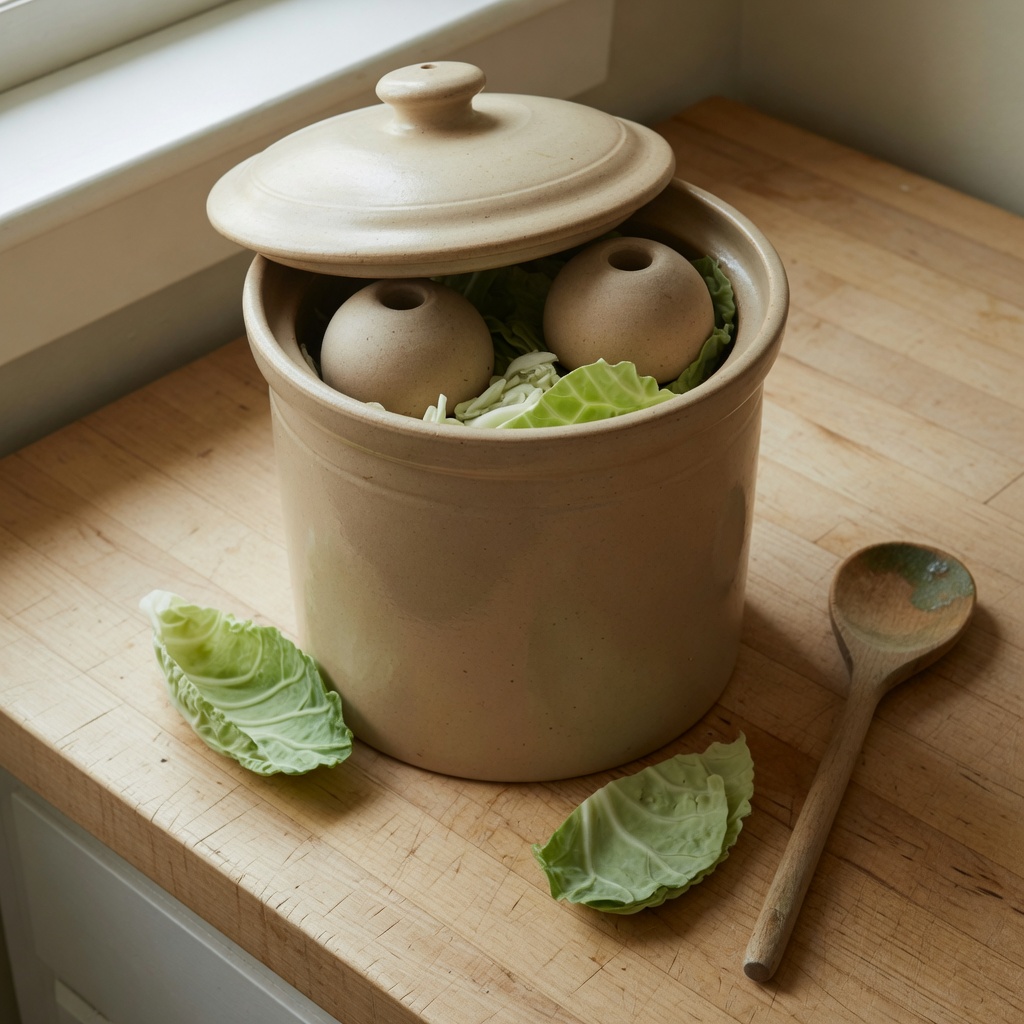
- The crock. Shred one head of cabbage, salt it, pack it into a ceramic fermentation crock (a big jar works too), and wait. Sauerkraut is nearly impossible to ruin and takes ten minutes of actual work. In two weeks you will have made food that keeps without a refrigerator, which is the whole ancestral trick in miniature.
- The key. Cut a spare key and hand it to one neighbor, with your phone number. Yes, this one is more of a leap. It was also the practice that made all her other practices work.
- The standing pot. Make soup on Sunday, on purpose, in a pot one size too big — and walk the extra quart to a specific door.
Notice what's not on the list: nothing tactical, nothing fear-flavored, nothing you'd hide from her. Every item would make sense to a woman born in 1930, which is roughly our test for whether a practice is resilience or theater.
Then say it out loud
Here is the step she didn't need and you do. Her street already knew she had a full cellar, because streets knew things then. Yours doesn't — modern streets are private by default, and privacy is fine right up until the night it makes everyone poorer.
So finish the ritual by declaring it: go to your street's inventory and add the one practice you adopted — the deep shelf, the crock, the too-big soup pot. That single declared line does quiet work. It tells the neighbor who's afraid of seeming weird that the water's fine. It gives your street one more known place where a little surplus lives. Two households declaring beats one household stockpiling, every time.
And if you chose the standing pot: you've already discovered that a shared meal is the conversion event this whole project runs on. We wrote down how to do it without it being strange. If you haven't yet named the three neighbors you could call at 2am, that's the companion ritual — and it pairs beautifully with a quart of soup.
One practice. One week. One line on the inventory. She'd think it was the least you could do — and she'd be right, which is exactly why it's the place to start.
Reading is a way of having. This post is a knowledge offering — thinner evidence than a practiced kit, thicker than an unread tab.